
Ask five social media managers about the ideal caption length, and you’ll likely get five different answers. Most of these recommendations stem from habit, a platform’s character limit, or a single post that performed well once. That is a shaky foundation for a content strategy, especially when caption length is one of the few variables your team fully controls on every post.
This article replaces guesswork with data. We analyzed millions of organic posts across Instagram, Facebook, LinkedIn, and TikTok to see how caption length affects engagement on each platform and in each format. The goal is to provide social media caption length best practices you can actually build a plan around. Let’s get into it.
Executive Summary
Instagram captions under 60 words get the highest engagement across all content formats, peaking at 0.37% for carousels. Facebook captions of 30 to 60 words get the highest engagement for Reels (0.28%), albums, and images, while status posts peak under 30 words. LinkedIn multi-image posts get the highest engagement with captions over 90 words (6.30%), while native documents perform best under 30 words. TikTok videos with captions under 30 words get the highest engagement rate (4.90%), and engagement drops with each longer bracket, down to 3.90% above 90 words.
What’s the Best Instagram Caption Length for Engagement?
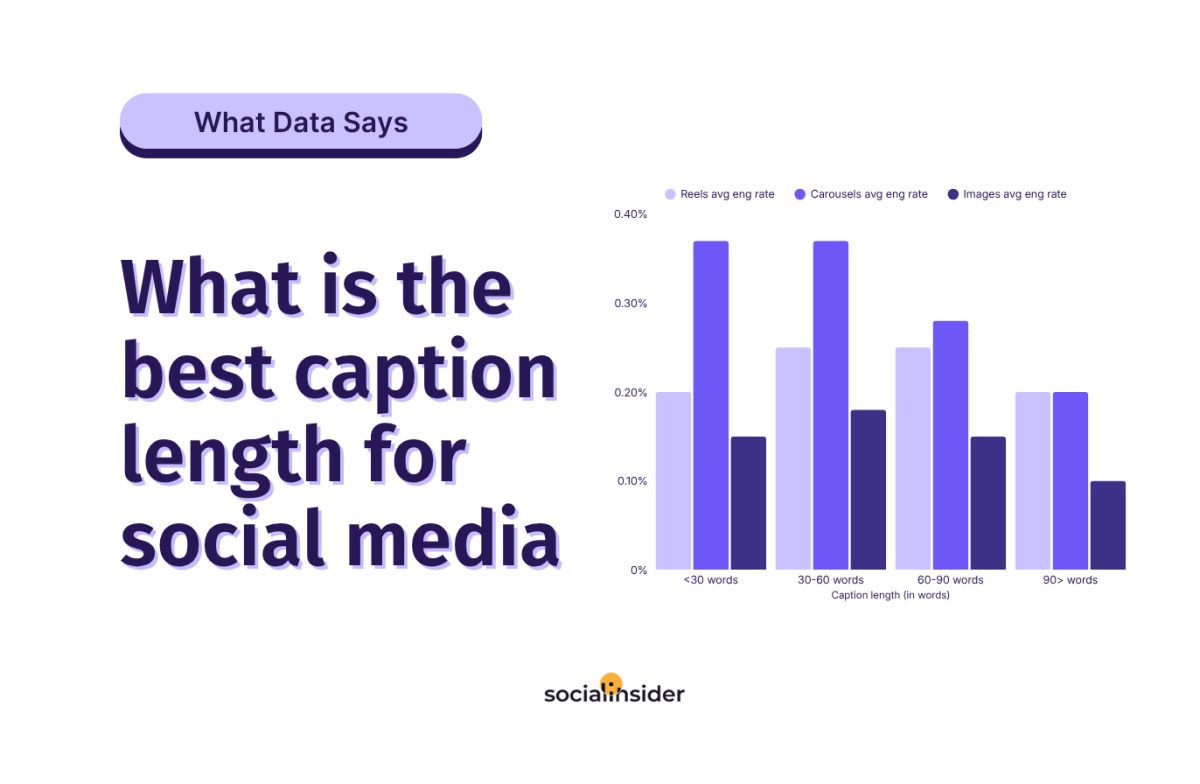
Key takeaway: Instagram carousels with captions under 60 words get the highest engagement rate (0.37%), and captions over 90 words perform worst for every format. So, does a longer caption on Instagram give your audience more reason to engage? Not really.
Here’s how engagement rate changes with caption length for each format:
| Caption length (in words) | Reels avg eng rate | Carousels avg eng rate | Images avg eng rate |
|---|---|---|---|
| <30 words | 0.20% | 0.37% | 0.15% |
| 30-60 words | 0.25% | 0.37% | 0.18% |
| 60-90 words | 0.25% | 0.28% | 0.15% |
| 90> words | 0.20% | 0.20% | 0.10% |
Carousels are the clearest case. With fewer than 60 words, they hold a 0.37% engagement rate, the highest of any format and length combination in the data. Past that value, engagement drops quickly. Carousels with 60 to 90 words get about 24% less engagement than shorter ones, and those with more than 90 words lose almost half of it.
Why would that happen? I’d guess it comes down to where the story is told. In a carousel, the slides already carry the message. A long caption competes with the swipe instead of supporting it. Reels follow a different pattern. The best range is wider, from 30 to 90 words, where engagement stays at 0.25%. Captions at either end, very short or very long, drop to 0.20%. And one pattern holds across all three formats: 90+ words is the weakest range every time.
Based on the data, here are some recommendations. Keep carousel captions short, under 60 words, and let the slides do the work. Give Reels and images enough copy to frame the post. Somewhere between 30 and 60 words is the safe range they share. Move longer explanations into the content itself, such as on-slide text, a voiceover, or a follow-up post, instead of the caption. Of course, these are aggregate benchmarks. Your audience may like longer captions, especially in industries where storytelling or education is part of the brand voice. Checking your own posts by caption length will show you whether your account follows this pattern or has a different sweet spot.
What’s the Best Facebook Caption Length for Engagement?
Key takeaway: On Facebook, Reels with captions of 30 to 60 words get the highest engagement rate (0.28%), while text-only status posts do best when kept under 30 words. Is there one caption length that works for everything on Facebook? Here’s what the data revealed.
| Caption length (in words) | Albums avg eng rate | Status posts avg eng rate | Reels avg eng rate | Images avg eng rate | Links avg eng rate |
|---|---|---|---|---|---|
| <30 words | 0.15% | 0.23% | 0.15% | 0.15% | 0.05% |
| 30-60 words | 0.17% | 0.10% | 0.28% | 0.14% | 0.05% |
| 60-90 words | 0.13% | 0.08% | 0.25% | 0.10% | 0.03% |
| 90> words | 0.13% | 0.15% | 0.20% | 0.10% | 0.03% |
Reels stand out first. Captions of 30 to 60 words give them a 0.28% engagement rate, the highest number in the entire Facebook dataset. Compare that with Reels under 30 words, which reach only 0.15%. Nearly double, just from adding a few lines of context. Facebook’s audience seems to want some framing before they commit to a video, more so than on Instagram. Engagement stays strong up to 90 words too, so you have room to work with.
If I were planning Facebook content around this data, I’d do three things. Treat 30 to 60 words as the default range for Reels, albums, and images. Keep text-only posts very short, or make them long enough to read as a full story. Keep link captions under 60 words, and expect link posts to drive clicks rather than engagement.
What’s the Best LinkedIn Caption Length for Engagement?
Key takeaway: On LinkedIn, multi-image posts with captions over 90 words get the highest engagement rate (6.30%), while native documents perform best with captions under 30 words. Does LinkedIn reward longer captions? For most formats, yes. It’s the platform where longer copy pays off the most.
Here’s how engagement rate changes with caption length for each format:
| Caption length (in words) | Native documents avg eng rate | Multi-image posts avg eng rate | Videos avg eng rate | Images avg eng rate | Polls avg eng rate | Text posts avg eng rate |
|---|---|---|---|---|---|---|
| <30 words | 6.30% | 4.80% | 2.90% | 4.20% | 3.50% | 2.80% |
| 30-60 words | 5.80% | 5.20% | 3.10% | 4.50% | 3.80% | 3.20% |
| 60-90 words | 5.20% | 5.80% | 3.30% | 4.70% | 4.00% | 3.50% |
| 90> words | 4.50% | 6.30% | 3.50% | 4.90% | 4.20% | 3.80% |
Multi-image posts are the clear winner here. With captions over 90 words, they achieve a 6.30% engagement rate, the highest in the entire LinkedIn dataset. That’s a massive jump from the 4.80% seen with captions under 30 words. The pattern suggests that LinkedIn users are willing to read longer, more detailed captions, especially when the post contains multiple images to break up the text.
Native documents, on the other hand, perform best with very short captions. Under 30 words, they hit 6.30% engagement, which then declines as captions get longer. This makes sense: a native document is already a self-contained piece of content, so a lengthy caption might feel redundant. Videos and text posts show a gradual increase in engagement as captions get longer, but the gains are more modest.
For LinkedIn, the data suggests a more nuanced approach. Use long captions (over 90 words) for multi-image posts to provide context and storytelling. Keep native document captions brief and let the document speak for itself. For videos and text posts, slightly longer captions (60 to 90 words) can help, but don’t overdo it. And as always, test with your own audience to see what resonates.
What’s the Best TikTok Caption Length for Engagement?
Key takeaway: TikTok videos with captions under 30 words get the highest engagement rate (4.90%), and engagement drops with each longer bracket, down to 3.90% above 90 words. On TikTok, brevity wins. The platform’s fast-paced, scroll-heavy environment leaves little room for lengthy captions. Short captions under 30 words achieve 4.90% engagement, while those over 90 words drop to 3.90%. That’s a 20% decrease just from adding more text.
Why does this happen? TikTok is all about the video itself. The caption is secondary, often used for context or hashtags. Users are there for entertainment, not for reading. So keeping captions concise and punchy is key. Use them to set the tone, ask a question, or include relevant hashtags, but don’t write a paragraph.
Putting It All Together
So what does this mean for your social media strategy? First, recognize that caption length is not a one-size-fits-all decision. Each platform has its own norms and user behaviors. Instagram favors shorter captions for carousels but allows a bit more for Reels. Facebook is similar but with a stronger preference for short text-only posts. LinkedIn is the outlier, rewarding longer captions for multi-image posts. TikTok demands brevity across the board.
Second, use these benchmarks as a starting point, not a rigid rule. Your audience might behave differently. Test different caption lengths and measure engagement. Look for patterns in your own data. Maybe your followers love detailed stories on LinkedIn, or maybe they prefer quick hits on Instagram. The key is to be intentional and data-informed.
Finally, remember that engagement is just one metric. While caption length can influence likes, comments, and shares, it’s not the only factor. Content quality, timing, visuals, and hashtags all play a role. Use caption length as a tool to optimize, but don’t obsess over it. The best caption is one that resonates with your audience and aligns with your brand voice.
As social media continues to evolve, so will the best practices for caption length. Platforms change their algorithms, user behaviors shift, and new formats emerge. The data we have today is a snapshot, not a permanent truth. Keep testing, keep learning, and keep adapting. After all, the only constant in social media is change.