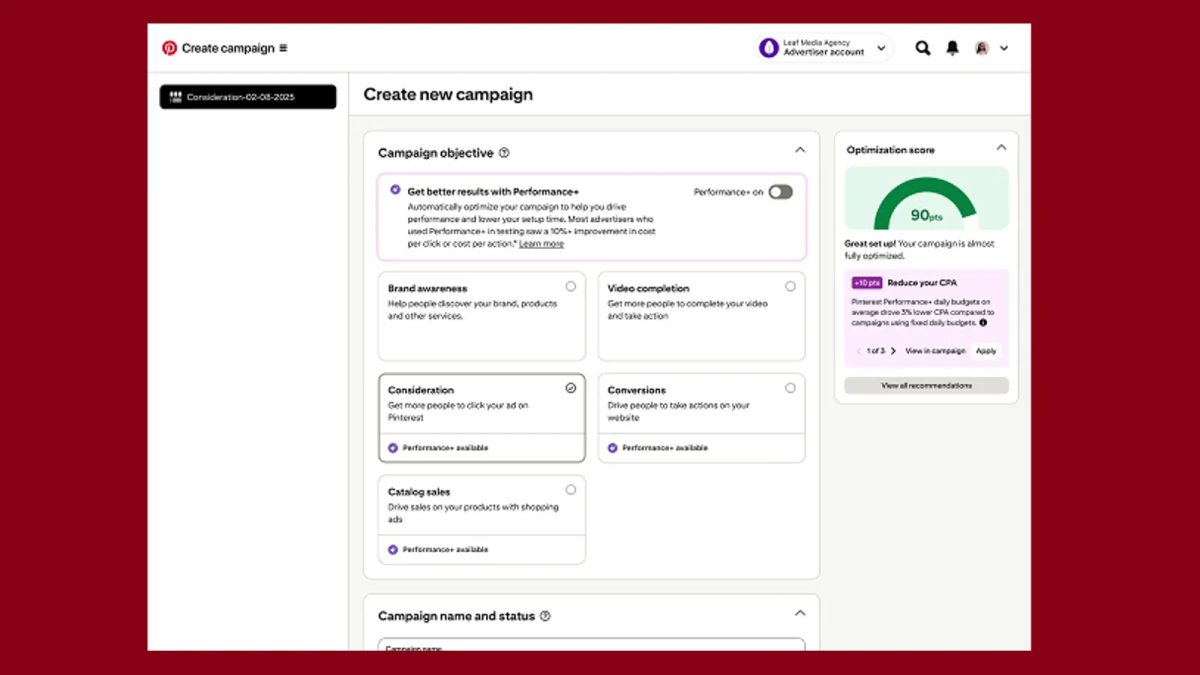

Pinterest just gave advertisers a new toy to play with, and it is powered by artificial intelligence. The platform has introduced a predictive optimization score for its Performance+ campaign suite, a tool designed to help marketers gauge how well their ads are put together before they ever go live. It is not just another dashboard metric; it is an attempt to turn guesswork into something closer to foresight.
What the Predictive Optimization Score Actually Does
At its core, the score evaluates the key components of an ad campaign, things like creative assets, targeting settings, bidding strategies, and budget allocation. Then it spits out a single number that reflects how likely that campaign is to hit its performance goals. Think of it as a credit score for your Pinterest ads, except instead of lenders, you are trying to impress an algorithm that decides who sees your content.
The system leans on machine learning models trained on historical campaign data across the platform. That means it learns from what has worked for other advertisers in similar verticals and surfaces recommendations tailored to your specific setup. If your score is low, the tool does not just flag the problem; it suggests concrete tweaks, like swapping in a different video format or adjusting your bid cap. It is like having a seasoned media buyer looking over your shoulder, minus the coffee breath.
Why Performance+ Matters for Pinterest’s Ad Business
Performance+ is Pinterest’s automated campaign type, launched to simplify ad buying for brands that do not have a dedicated growth team. It handles everything from audience expansion to dynamic creative optimization, leaving advertisers to focus on strategy rather than button-pushing. Adding predictive scoring to the mix turns Performance+ from a set-it-and-forget-it tool into something more like a co-pilot that actually talks back.
For Pinterest, this is a strategic play. The platform has spent years positioning itself as a discovery engine where users come with purchase intent, not just to scroll mindlessly. But convincing performance marketers to shift budget from Meta or Google requires proof that Pinterest can deliver measurable returns. A predictive score that demonstrably improves campaign outcomes could be that proof. Or at least, it could keep advertisers from abandoning ship after one bad quarter.
How Advertisers Can Use the Score Without Losing Their Minds
First, do not treat the score as gospel. It is a directional signal, not a guarantee. A campaign with a perfect score can still flop if your product is boring or your landing page loads like a dial-up modem. Use the score to prioritize which campaigns need attention, then apply human judgment to the recommendations.
Second, test the suggestions incrementally. If the tool tells you to switch from static image to carousel, try it on a small budget first. Pinterest’s AI is smart, but it does not know your brand voice or your margins. You do. The best results come from a feedback loop where you run experiments, feed the results back into the system, and let the score evolve alongside your strategy.
Third, watch for score inflation. Any optimization metric can be gamed, and Pinterest’s predictive model is no exception. If everyone starts optimizing for the same signals, the score becomes less useful as a differentiator. The real edge will come from combining the score with proprietary data, like customer lifetime value or offline conversion rates. That is where the humans still win.
The Broader Shift Toward Predictive Ad Tech
Pinterest is not alone in this move. Google, Meta, and TikTok have all rolled out similar scoring systems, though each with its own flavor. The industry is moving toward a model where AI does not just execute campaigns but also diagnoses them before they launch. It is a logical next step as ad platforms accumulate more data and advertisers demand faster iteration cycles.
But there is a tension here. The more platforms rely on black-box predictive models, the harder it becomes for advertisers to understand why a campaign succeeded or failed. That opacity can breed distrust, especially when budgets are tight. Pinterest’s challenge will be to make the predictive score transparent enough that marketers feel informed, not manipulated. Early signs suggest the company is at least trying, with explanations for each recommendation and a breakdown of contributing factors.
For now, the predictive optimization score is available to all Performance+ users, though Pinterest says it will continue refining the model based on feedback. If it works as advertised, it could become a standard feature across the platform, and eventually, a reason for performance marketers to give Pinterest a second look. After all, in a world where every dollar is scrutinized, a tool that helps you waste fewer of them is worth paying attention to.
What comes next? Likely deeper integration with Pinterest’s shopping features, so the score can factor in product feed quality and catalog completeness. Or maybe a benchmarking feature that shows how your score compares to competitors in your niche. Either way, the line between human strategist and machine advisor is getting blurrier, and Pinterest just took another step across it.