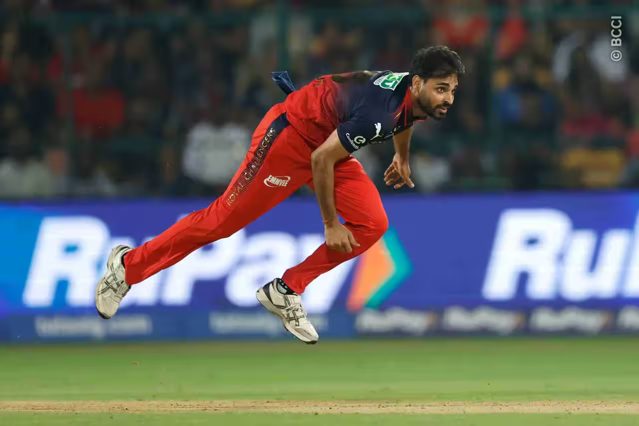

The Indian Premier League is a tournament often defined by its explosive batting, where sixes are currency and strike rates are king. Yet, amidst the cacophony of cracking willow, a quieter, more precise art has just claimed a monumental first. Bhuvneshwar Kumar, the Sunrisers Hyderabad seamer with the demeanor of a chess grandmaster, has become the first pace bowler in IPL history to reach the 200-wicket milestone. It’s a feat that recalibrates our understanding of dominance in a format seemingly designed to humble bowlers.
The Significance of a Pace Pioneer
Think about that for a moment. In sixteen seasons of high-octane T20 cricket, with its flat pitches, short boundaries, and fielding restrictions, no fast bowler had breached this barrier before. Spinners, with their guile and economy, had led the wicket-taking charts. Bhuvneshwar’s achievement is akin to a marathon runner breaking the tape in a sprint event; it underscores a different kind of athleticism and strategic brilliance. It proves that consistency, intelligence, and skill can triumph over raw power, even in the most batter-friendly environment imaginable.
His journey to 200 is a masterclass in adaptation. He debuted as a young swing bowler who could move the new ball prodigiously, a rare skill in the IPL. As the balls got older and the batsmen more aggressive, he didn’t just survive; he evolved. He developed a lethal knuckleball, one of the best in the world, and honed his death-over yorkers to a surgical precision. This wasn’t about bowling the fastest, but about bowling the smartest. Each wicket represents a solved puzzle, a batter out-thought as much as out-played.
Navigating the Elite Wicket-Takers List
Where does this landmark place him in the pantheon of IPL greats? The overall wicket-takers list is still commanded by the wizards of spin. He currently sits just behind the league’s all-time leading wicket-taker, Yuzvendra Chahal, a leg-spinner whose repertoire is the polar opposite of Bhuvneshwar’s. That juxtaposition is fascinating. Chahal operates through deception in the air, while Kumar relies on deception off the pitch and through changes of pace. They are the yin and yang of IPL bowling success, proving there are multiple paths to the top.
The list of top wicket-takers is a who’s who of T20 bowling, featuring names like Dwayne Bravo, Lasith Malinga, and Amit Mishra. But until now, the pinnacle for a fast bowler was a ceiling. Bhuvneshwar has effectively installed a new floor, a benchmark that redefines what is possible for the coming generation of quicks. It’s a record that speaks not to a purple patch of form, but to a career of sustained excellence across more than a decade. In a league with relentless player turnover, that longevity is itself a monumental achievement.
The Anatomy of a Modern T20 Seamer
So, what can aspiring fast bowlers and even data analysts learn from the Kumar blueprint? His success is built on a foundation of exceptional skill execution married to acute situational awareness. He understands that in T20 cricket, a dot ball can be as valuable as a wicket, and his economy rate has always been a weapon. He bowls to specific, data-informed plans for each batter, but retains the ability to improvise when the match situation demands it. This blend of pre-meditated strategy and in-game intuition is the hallmark of a true craftsman.
Consider the tools in his kit. The outswinger to the right-hander remains a classic, but it’s the variations that follow that create the pressure. The back-of-the-hand slower ball that seems to hang in the air, the perfectly disguised wide yorker, the cutter that grips the surface. He operates like a programmer with a flawless code library, calling the right function at the precise moment to crash the opponent’s system. For tech-savvy fans, he’s the elegant, efficient algorithm in a league full of brute-force scripts.
Beyond the Numbers: Context and Legacy
Milestones in sports are rarely just about the number. This one arrives as the IPL continues to evolve into an even more data-intensive and analytically driven competition. Teams have vast troves of information on every bowler’s tendencies, every batter’s weaknesses. To thrive in that environment, a bowler must have either unplayable mystery or impeccable control. Bhuvneshwar embodies the latter. His record is a testament to the enduring value of fundamentals in an era of innovation.
His legacy will likely be measured by more than just this singular record. He has been the silent architect of numerous Sunrisers Hyderabad victories, often bowling the crucial 18th or 20th over under immense pressure. He’s the bowler his captains turn to when the game is in the balance, a trust earned through years of delivering in those clutch moments. In a league of flashy headlines, his has been a career of understated mastery.
The Future of Fast Bowling in the IPL
What does this mean for the future? Bhuvneshwar Kumar has effectively charted a course. He has shown that for a fast bowler, IPL longevity isn’t about preserving express pace, but about cultivating a deep and versatile skill set. The next generation, from Arshdeep Singh to Mohsin Khan, will look at his career as a roadmap. They will see that swing, seam, and smarts can carve out a fifteen-year career at the top, that there is space for the thinker alongside the tearaway.
The race to 250 wickets now begins, and it will be intriguing to see if another pacer can ever challenge his tally. With T20 cricket constantly accelerating, bowlers are under more pressure than ever. Yet, Kumar’s milestone is a powerful reminder that in the high-stakes algorithm of modern cricket, there will always be a premium on human skill, adaptability, and cold-blooded execution. The first fast bowler to 200 IPL wickets hasn’t just taken a record; he’s redefined the art of pace bowling in the franchise era.