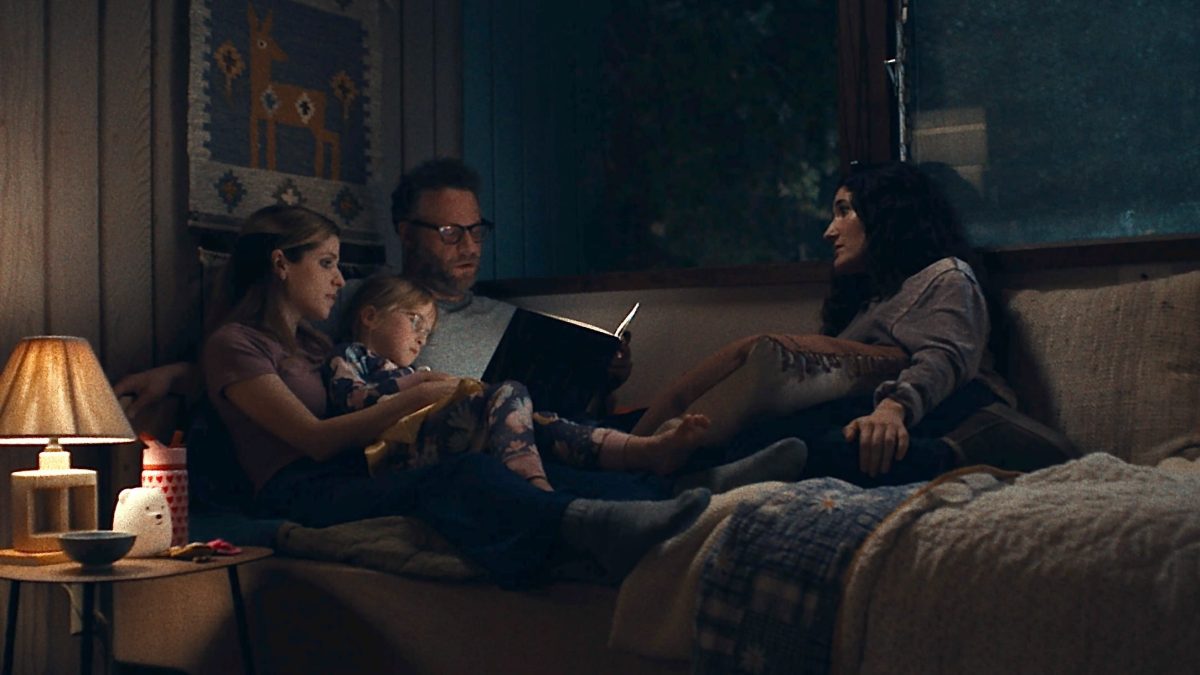

There is a particular kind of social ambush that people without children know all too well. It usually arrives at a family gathering, a work party, or a casual brunch, and it comes wrapped in a smile that is supposed to make the intrusion feel affectionate. A hand lands on your belly, a question masquerading as small talk slips out, and suddenly your reproductive choices are up for public debate. Lauren Miller Rogen and Seth Rogen understand this dynamic intimately, and their new comedy Babies takes aim at it with the kind of humor that feels less like a punchline and more like a pressure valve finally releasing.
Why the Child-Free Narrative Has Been Stuck in the Punchline Zone
For decades, pop culture has treated adults who choose not to have kids as either tragic figures or selfish caricatures. Think about the standard sitcom setup: the couple who insists they are happy without children is usually just one episode away from a life-changing revelation. The message, subtle or not, is that their contentment is temporary and their real life has not started yet. It is a narrative that reinforces a heteronormative script, one where marriage and parenthood are assumed to be the default settings rather than one option among many.
What makes Babies noteworthy is not that it simply flips this script. Plenty of films have tried to show child-free couples as cool, successful, or adventurous, only to undercut them with a third-act conversion. Instead, the Rogen and Miller Rogen project treats the decision to remain childless as a legitimate, permanent, and even joyful way to build a life. The comedy comes from the absurdity of the pressure itself, not from the people who are enduring it. That distinction matters more than it might seem on the surface.
It is a subtle but powerful reframing. When the joke is on the couple who cannot stop asking invasive questions, the audience dynamic shifts. Child-free viewers are no longer the subject of the punchline; they are the ones in on the joke. And for anyone who has ever been grabbed by the belly at a baby shower, that shift feels like a long-overdue correction.
How Seth Rogen and Lauren Miller Rogen Use Humor as a Social Lens
Seth Rogen has built a career on playing variations of the same lovable man-child, but his off-screen collaboration with Miller Rogen has always had a sharper edge. Their previous work together, including Long Shot and various advocacy projects, tends to blend raunchy comedy with genuine emotional intelligence. Babies continues that tradition, using the familiar rhythms of a relationship comedy to explore a topic that rarely gets this kind of nuanced treatment. The humor is not mean-spirited, but it is pointed, and it lands because the observations are so recognizable.
Consider the scene where a well-meaning relative corners the couple at a holiday dinner. The dialogue is exaggerated for comedic effect, but the underlying dynamic is painfully real. The relative is not trying to be cruel; they genuinely believe they are being helpful. That is what makes the moment so effective. The film understands that most of the pressure child-free couples face does not come from villains. It comes from people who love them and simply cannot imagine a different kind of happiness.
Miller Rogen, who co-wrote and stars in the film, brings a specificity to the material that feels lived-in. Her character does not spend the entire runtime defending her choices. She has moments of doubt, moments of frustration, and moments of pure, unapologetic joy in her child-free life. That range is crucial. It prevents the film from becoming a simple advocacy piece and turns it into something more honest: a portrait of a couple trying to navigate a world that keeps asking them to justify their own contentment.
The Broader Cultural Conversation That ‘Babies’ Enters
The timing of this release is not accidental. Conversations about reproductive autonomy, chosen family structures, and the rising number of adults who are opting out of parenthood have moved from the margins to the mainstream. According to recent demographic data, birth rates in many developed countries have been declining for years, and a growing share of that decline is driven by intentional choice rather than circumstance. People are not just having fewer children later; many are deciding not to have them at all. Yet the cultural scripts around adulthood have been slow to catch up.
That gap between lived reality and cultural representation is exactly where Babies finds its footing. It does not pretend that choosing not to have children is always easy or universally accepted. It also does not portray the decision as a political statement, even though it inevitably becomes one in certain rooms. Instead, it treats the choice as just that: a choice. And in doing so, it offers something that has been surprisingly rare in mainstream comedy, a depiction of child-free adulthood that is neither a cautionary tale nor a temporary phase.
For tech and developer audiences, there is a parallel worth noting. The industry has long grappled with its own version of this pressure, where career trajectories and life milestones are often assumed to follow a single template. The rise of remote work, the rethinking of hustle culture, and the growing emphasis on sustainable careers have all challenged those assumptions. Babies does not speak directly to those professional debates, but the underlying theme of rejecting a predetermined script resonates far beyond the family dinner table.
What This Means for the Future of Comedy and Representation
If Babies succeeds, it will not be because it solves a cultural debate. It will be because it makes a segment of the audience feel seen without turning them into a case study. That is a harder trick than it sounds. Comedy has always been a powerful tool for normalizing experiences that have been othered or overlooked, and the child-free community has been waiting for its turn. The Rogen and Miller Rogen project does not claim to speak for everyone, but it offers a template for how to do so with wit and without apology.
The real test will be whether this opens doors for more stories that treat reproductive choice as a spectrum rather than a binary. There is room for narratives about people who want children but cannot have them, people who are ambivalent, and people who change their minds in either direction. The more these stories are told with honesty and humor, the less power the old stigma will have. And if a few belly-grabbing relatives end up feeling a little uncomfortable in the process? That might just be the best punchline of all.