Big marketing ambitions on a shoestring budget? You are not alone. After more than a decade of marketing for bootstrapped brands, I have learned that you do not need to spend a fortune on fancy digital marketing tools to see real results.
It is all about building a smart toolkit that punches above its weight. One that helps you work efficiently and get results without breaking the bank. That is where this comprehensive list comes in: 28 digital marketing tools that help growing brands succeed. Many of these tools offer free or low-cost versions, so you can start small and scale up as you are ready for more features.
Why a Smart Marketing Tech Stack Matters
Consider this your guide to building a powerful marketing technology stack that works within your budget. The core insight? You can assemble a complete starting stack for exactly $0. Buffer’s free plan, Canva’s free plan, Google Analytics, and Google Search Console cover publishing, design, and measurement without a credit card. That is not a trial. That is a genuinely usable foundation.
For social media on a small budget, Buffer’s free plan then costs $6 per month per channel, so cost scales with channels rather than seats. That distinction matters when you are a team of one or two. Email tools? Mailchimp is free to 250 contacts and paid plans start from $13 per month. For ecommerce email and SMS, Klaviyo is free to 250 contacts and 500 sends, then $20 per month for email or $35 per month for email and SMS.
Social Media Marketing Tools That Keep You Consistent
For most small businesses, Buffer (free plan; paid plans from $6 per month per channel) is the best place to start. Mentionlytics ($69 per month) and Predis.ai (free plan) can add social listening and competitor insights. These social media tools help you maintain a consistent social media presence and evaluate your content performance.
A social media management tool is central to any social strategy. It helps you manage your online presence so you can post consistently and on a schedule you choose, which can help improve engagement. I have been a Buffer customer and fan for nine years, long before I started contributing to the blog. And when I became more active in building my personal brand a year ago, Buffer was the natural choice.
Buffer: Social Media Management for Creators and Small Businesses
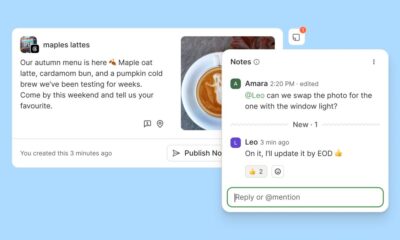
Since this is the Buffer blog, we are naturally excited to share how Buffer can help with your social media management. The tool captures and organizes all your social media ideas in the Create space. It tracks and responds to comments on Facebook, Instagram, LinkedIn, Threads, X/Twitter, and Bluesky in a streamlined dashboard. You can schedule finished posts in your social queue. The AI assistant helps you generate ideas, repurpose content, and edit posts to perfection. Buffer’s Insights shows you your cross-channel performance in easy-to-understand graphs. Buffer’s API, MCP, and connectors allow you to plug it into ChatGPT, Claude, or your AI tool of choice.
The Create space is one of my favorite features. I love how I can tag and organize everything by color, in Kanban columns. I log all my half-baked ideas here and move them along in my custom Kanban board as they progress. I even have a prompts category for ideas in case I get stuck (many of which came from Buffer’s Creator Camp). But there is a nifty generate ideas button that can jumpstart your content creation. From here, you can drag ideas into your queue and watch them become published posts.
Email and SMS Marketing Tools for Every Business Size
Email remains the workhorse of digital marketing, and the right tool depends on your business model. Mailchimp is the best email tool under $15 per month, free to 250 contacts and paid from $13 per month. Klaviyo is best for ecommerce email and SMS, free to 250 contacts and 500 sends, then $20 per month for email or $35 per month for email and SMS. HubSpot works well for B2B email and lead management, with a free plan and paid from $10 per user per month. Kit suits solopreneurs selling digital products, free for up to 10,000 subscribers then $39 per month. beehiiv is built for newsletters by content creators, free for up to 2,500 subscribers then $49 per month.
SEO Tools That Reveal What Google Actually Thinks
Google Search Console is the best free SEO tool, the most direct way to understand how your site performs in Google Search. For paid options under $50 per month, Moz has plans from $49 per month and Frase offers long-form content optimization with a free trial then $49 per month. Do not overlook the free tool that tells you what queries you already rank for. That data is pure gold.
Content and Design Tools for Marketers Who Cannot Draw
Canva is the obvious starting point for graphic design, with a free plan and paid from $18 per month. Adobe Firefly provides commercial-friendly AI images, free with a watermark or $9.99 per month without. VEED handles simple video editing with a free version that includes a watermark or $20 per user per month. Butter is built for ecommerce product video, free plan then $25 per month. Claude handles AI writing, free version then $20 per month.
The best AI images you can use commercially come from Adobe Firefly because it is trained on licensed content. That matters if you are selling products or running ads. You do not want legal headaches from an image generator that scraped the open web.
Conversion Optimization and Paid Advertising Tools
VWO handles A/B testing, with pricing available by scheduling a demo. ConvertFlow covers website personalization and funnel building, free plan then $29 per month. Aftersell focuses on ecommerce revenue optimization at $29.99 per month. WordStream grades your Google Ads account for free. Atria optimizes Meta and TikTok ads at $159 per month.
These tools are not for everyone at the start. But once you have traffic and a budget, they help you squeeze more revenue from the same visitors. That is the difference between spending more and earning more.
Marketing Analytics Tools That Tell You What Works
Google Analytics is free and covers website analytics. Contentsquare offers website engagement analytics with a free plan available then $49 per month. Amplitude provides product and app analytics, free for up to 2 million events per month then $94 per month. Lifetimely tracks Shopify customer lifetime value, free for up to 50 orders per month then $49 per month.
Analytics is where most small businesses get overwhelmed. Start with Google Analytics and Google Search Console. Add Amplitude when you have a product or app. Add Lifetimely when you sell on Shopify and want to know which customers are worth the most.
How to Build Your Stack Without Wasting Money
Start with the cheapest complete starting stack: $0. Buffer’s free plan, Canva’s free plan, Google Analytics, and Google Search Console. That covers publishing, design, and measurement. Then add one paid tool when you hit a real limit, not before.
For social media on a small budget, Buffer’s free plan then $6 per month per channel means cost scales with channels rather than seats. For email under $15 per month, Mailchimp starts free and paid from $13 per month. For ecommerce email and SMS, Klaviyo starts free and paid from $20 per month for email or $35 per month for email and SMS. For free SEO, Google Search Console is the most direct way to understand your Google performance. For paid SEO under $50 per month, Moz starts at $49 per month. For AI images you can use commercially, Adobe Firefly costs $9.99 per month without a watermark.
The future of small business marketing is not about having the biggest budget. It is about having the smartest stack. The tools above prove you can compete with the big guys by being efficient, consistent, and data-driven. Start free, scale when you are ready, and let the results guide your next move.