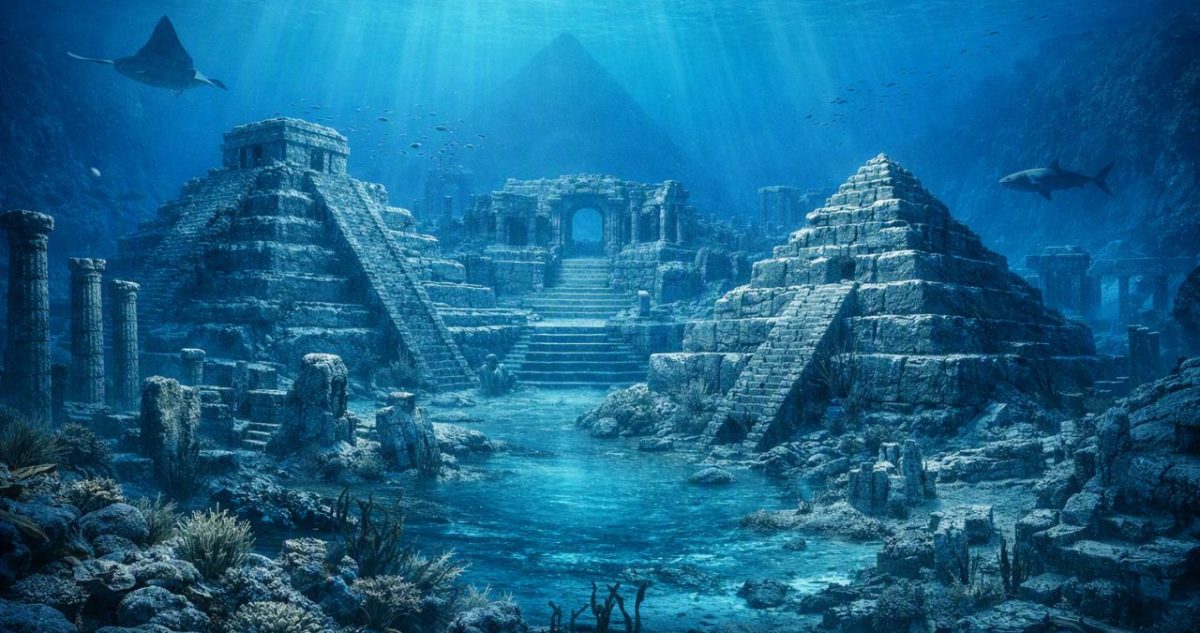

Every few years, a sonar image or a grainy video surfaces from the deep ocean, and the internet collectively loses its mind. The latest culprit? A sprawling, geometric formation resting nearly 3,000 feet below the surface of the Atlantic, just north of the Bermuda Triangle. It stretches for seven miles, and its grid-like patterns have been touted by online theorists as everything from a lost Atlantis to an alien waystation.
But before you pack your scuba gear and brush up on your ancient Greek, let’s look at what’s actually down there. The structure, first detected by oceanographers in 2012 using sonar mapping, is indeed striking. It features sharp angles, parallel lines, and what appear to be rectangular blocks. In low-resolution sonar, it looks like a metropolis frozen in time.
Why Sonar Images Can Be Deceiving
Here’s the thing about sonar: it’s essentially a microphone screaming into the dark and timing the echo. When that sound wave hits a hard surface like rock or metal, it bounces back brightly. When it hits soft sediment or sand, the return is dimmer. The problem is that sonar doesn’t distinguish between a man-made wall and a natural geological fault. Both can produce the same crisp, geometric reflection.
Dr. Emily Petrova, a marine geologist who has studied the region, explains that the Atlantic seafloor is a chaotic place. Tectonic activity, underwater landslides, and millennia of sediment compression can create surprisingly regular patterns. “Nature is lazy,” she says. “It reuses the same angles and fractures over and over. A hexagonal crack in a basalt flow looks a lot like a hexagonal paving stone.”
Then there’s the matter of scale. Seven miles is enormous. If this were a city, it would be larger than modern-day Manhattan. The logistical footprint required to build such a thing underwater, without any trace of tools, waste, or habitation, is mind-boggling. Occam’s razor suggests a simpler answer: we are pattern-matching on a cosmic scale.
The Bermuda Triangle Connection: A Distraction
It’s tempting to link this formation to the Bermuda Triangle’s reputation for vanishing ships and planes. But that’s a narrative trap. The Triangle itself is a statistical illusion. The region is heavily trafficked, and its storms are notoriously violent. Insurance records show no higher rate of disappearance than anywhere else in the ocean. The “mystery” is a product of selective reporting and a few sensationalist books from the 1970s.
What the seafloor structure actually represents is far more interesting to scientists. It appears to be a series of ancient, now-submerged shoreline features. During the last ice age, sea levels were hundreds of feet lower. Beaches, dunes, and coastal rock formations were exposed to the air. As the glaciers melted, the ocean swallowed them whole. The “city blocks” are likely compacted sand and peat layers that hardened over time, then fractured into angular shapes.
In 2018, a team from the National Oceanic and Atmospheric Administration (NOAA) sent a remotely operated vehicle (ROV) to the site. They found no columns, no inscriptions, no pottery. Just rock. Beautiful, complex, geologically mundane rock. The ROV footage showed encrusting sponges and deep-sea corals clinging to the ridges. It was a thriving ecosystem, not a ruin.
Why We Want to Believe
So why does this story keep resurfacing? Because the deep ocean is our planet’s final frontier. We have better maps of Mars than of our own seafloor. Every sonar anomaly is a blank canvas for our imagination. Lost civilizations, sunken UFOs, ancient advanced tech: these tropes tap into a deep-seated desire for wonder and a distrust of mainstream science.
Social media algorithms love this stuff. A headline like “Sunken City Found” generates clicks, shares, and furious comment debates. A headline like “Compacted Sedimentary Layers Resemble Urban Grid” does not. The result is a cycle where sensationalism outruns peer review every single time.
This doesn’t mean the ocean isn’t full of surprises. It absolutely is. We discover new species, new hydrothermal vents, and new shipwrecks constantly. But the bar for evidence in archaeology and geology is high for a reason. Extraordinary claims require extraordinary proof, not just a fuzzy sonar blip and a YouTube documentary.
What Comes Next for the ‘Sunken City’?
The site will likely continue to be studied by geologists interested in paleo-shorelines and sea-level rise. Understanding how these formations were created helps us model future coastal flooding and tectonic shifts. For the rest of us, it’s a reminder that the ocean floor is a dynamic, messy place. It doesn’t need aliens or Atlanteans to be fascinating.
Next time you see a viral post about a mysterious underwater structure, ask yourself: where is the peer-reviewed paper? Where is the sample data? And most importantly, does the explanation require a conspiracy that spans thousands of years and thousands of scientists? If so, it’s probably just rock. Very old, very cool, very natural rock.